
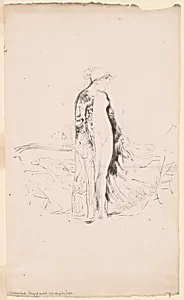
Draped Model, Standing by a Sofa
1893 (printed posthumously 1904)
Medium
Transfer lithograph in black ink on cream laid paper
Dimensions
Image: 20.6 × 16 cm (8 1/8 × 6 5/16 in.); Sheet: 37.8 × 22.9 cm (14 15/16 × 9 1/16 in.)
Classification
Department
Prints and Drawings
Museum
Art Institute of Chicago
Accession Number
139595
Rights
Public Domain
Art Historical Context
James McNeill Whistler’s *Draped Model, by a Sofa* (1893, printed posthumously in 1904) captures the intimate grace of a figure study through the delicate medium of transfer lithography. Printed in black ink on cream laid paper this work measures a modest 20.6 × 16 cm for the image, inviting close contemplation. Whistler, a leading figure in the Aesthetic movement, championed "art for art’s sake," prioritizing tonal harmony and subtle beauty over narrative detail. Here, the draped model poised by a sofa exemplifies his late-career fascination with everyday studio scenes, rendered with fluid lines that evoke serenity and form. Lithography allowed Whistler to explore printmaking’s potential for painterly effects, transferring drawings from paper to stone for multiple impressions. This posthumous edition, produced a year after his death in 1903, reflects the enduring demand for his innovative prints, which bridged Realism and Impressionism while drawing from Japanese aesthetics. Housed in the Art Institute of Chicago’s Prints and Drawings department, it showcases Whistler’s mastery in distilling human presence into atmospheric elegance. Visitors will appreciate how this piece reveals the artist’s meticulous process—soft drapery folds and poised silhouette—offering a window into the quiet poetry of the studio life Whistler so elegantly immortalized.
About the Artist
James McNeill Whistler · 1834–1903
James Abbott McNeill Whistler (1834-1903) was an American-born painter and printmaker who became a leading figure in the Aesthetic Movement and pioneer of Tonalism and Japonisme. He revolutionized art by championing "art for art's sake" and treating paintings as visual equivalents of musical compositions, titling works as "arrangements," "harmonies," and "nocturnes" to emphasize formal qualities o...