
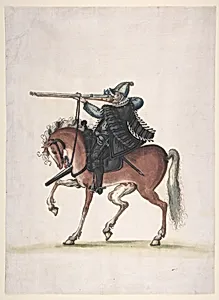
Drawing of a Mounted Arquebusier (Soldier on Horseback)
Unknown Artist
late 16th century
Medium
Water color, paper
Dimensions
12 7/8 x 9 1/2 in. (32.7 x 24.1 cm)
Classification
Works on Paper-Drawings
Culture
Austrian
Department
Arms and Armor
Museum
Metropolitan Museum of Art, New York, NY
Credit
Rogers Fund, 1927
Accession Number
27.68.8
Rights
Public Domain
Tags
Art Historical Context
This delicate watercolor drawing from late 16th-century Austria captures a mounted arquebusier—a cavalry soldier armed with an arquebus, of the era's early muzzle-loading firearms. Rendered on paper in precise lines and subtle washes, the 12⅞ × 9½-inch work showcases the rider's dynamic pose astride his horse, evoking the blend of chivalric tradition and emerging gunpowder technology. Housed in the Metropolitan Museum of Art's Arms and Armor Department, it exemplifies how such sketches served as vital records of military attire, equipment, and tactics. Created during the height of the Habsburg Empire's power, when Austria faced Ottoman threats and religious wars, the image reflects the transformative shift in European warfare. Arquebusiers on horseback represented an innovative response to infantry firearms, allowing mobile firepower that revolutionized cavalry roles. The unknown artist's keen attention to details like the soldier's plumed helmet, ornate saddle, and the arquebus's matchlock mechanism highlights the cultural prestige of these elite troops. As a "work on paper," this drawing's watercolor medium allowed for portable, detailed studies prized by collectors and arsenals. Acquired through the Rogers Fund in 1927, it invites visitors to ponder how art documented the gritty evolution of combat, bridging Renaissance aesthetics with the dawn of modern armies.