
Drawing of an Angel
Unknown Artist
16th century
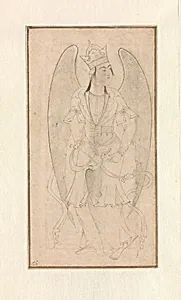
Medium
Ink and gold on paper
Dimensions
H. 5 1/4 in. (13.3 cm) W. 2 7/8 in. (7.3 cm)
Classification
Codices
Department
Islamic Art
Museum
Metropolitan Museum of Art, New York, NY
Credit
Louis E. and Theresa S. Seley Purchase Fund for Islamic Art, 2004
Accession Number
2004.35
Rights
Public Domain
Tags
Art Historical Context
This delicate *Drawing of an Angel*, by an unknown artist in the 16 century, exemplifies the exquisite miniature tradition of Islamic art. Rendered in ink and gold on paper, it measures just 5 1/ by 2 7/8 inches, a size perfectly suited for inclusion in aex—a bound manuscript often used for religious texts, poetry, or scientific works. Housed in the Metropolitan Museum of Art's Islamic Department, it was acquired through the Louis E. and S. Seley Purchase in 2004. In the vibrant artistic centers of the 16th century—such as Safavid Persia or the Ottoman Empire—such illustrations brought spiritual realms to life. Angels, revered in Islamic tradition as messengers of God, frequently appeared in manuscript illuminations depicting paradise, prophetic visions, or celestial hierarchies. This work's classification as part of a codex underscores its role in enriching sacred or literary narratives, where imagery enhanced the written word without dominating it. The technique of ink outlining paired with shimmering gold highlights reveals masterful control and opulence. Gold, symbolizing divine light, catches the eye, inviting contemplation of the ethereal. Though the artist remains anonymous, as was common in workshop traditions, this piece captures the period's blend of piety, precision, and poetic beauty, offering visitors a window into Islam's rich visual heritage.