
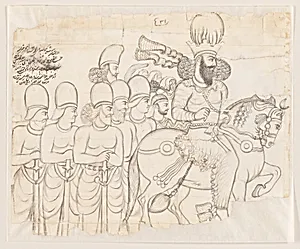
Drawing of Sasanian rock relief: Shapur I (r. A.D. 241-272) and members of his court at Naqsh-i Radjab, southern Iran
A.H. 1226/1812 CE
Medium
Paper, pencil, ink
Dimensions
10 1/16 × 10 1/4 in. (25.5 × 26 cm)
Classification
Paper-Graphics-Inscribed
Culture
Qajar
Department
Ancient Near Eastern Art
Museum
Metropolitan Museum of Art, New York, NY
Credit
Gift of Sassan Mokhtarzadeh, 1998
Accession Number
1998.6.1
Rights
Public Domain
Tags
About this artwork
This drawing by Lutf-'Ali Shirazi documents a Sasanian rock relief depicting Shapur I and members of his court at Naqsh-i Radjab in southern Iran. Created in A.H. 1226 (1812 CE), the work exemplifies the Qajar period's scholarly interest in documenting Persia's pre-Islamic monuments. Executed in pencil and ink on paper, the drawing measures 25.5 by 26 centimeters. Shapur I ruled the Sasanian Empire from A.D. 241 to 272, presiding over one of Persia's most powerful dynasties. The original rock r...
Art Historical Context
This delicate 1812 drawing by the Qajar artist Lutf-'Ali Shirazi captures a Sasanian rock relief at Naqsh-i Radjab in southern Iran, showing powerful ruler Shapur I (r. 241–272 CE) alongside members of his court. Created in pencil and ink on paper, the work measures just over ten inches square and reflects the era’s growing fascination with Iran’s ancient heritage. Shirazi’s precise lines record figures, costumes, and inscriptions from the weathered stone monument near Persepolis, preserving visual details that might otherwise have been lost. Shapur I presided over one of the Sasanian Empire’s most influential periods, and the original reliefs at Naqsh-i Radjab commemorated royal ceremonies and divine kingship. By the early nineteenth century, both Persian and European scholars sought to document these pre-Islamic monuments. Shirazi’s drawing exemplifies this scholarly impulse, serving as an important bridge between ancient history and Qajar antiquarian interests. Donated to the Metropolitan Museum in 1998, the sheet offers modern viewers a rare glimpse into how 19th-century artists helped safeguard knowledge of Iran’s past before photography became widespread.