
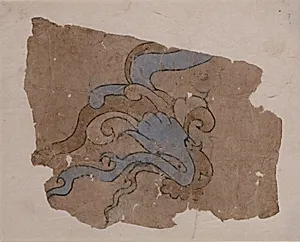
Drawing of the Head of a Simurgh
Unknown Artist
14th century
Medium
Ink and opaque watercolor on paper
Dimensions
H. 5 1/2 in. (14 cm) W. 4 5/8 in. (11.8 cm)
Classification
Codices
Department
Islamic Art
Museum
Metropolitan Museum of Art, New York, NY
Credit
Fletcher Fund, 1971
Accession Number
1971.237.2
Rights
Public Domain
Tags
Art Historical Context
This delicate 14th-century drawing titled *Drawing of the Head of Simurgh*, captures the majestic visage of one of Persian mythology's most revered mythical creatures—a benevolent, phoenix-like bird symbolizing wisdom and protection. Created by an unknown artist in the Islamic world, likely as part of a codex or illuminated manuscript, it exemplifies the exquisite miniature tradition of Persian art. Measuring just 5½ by 4⅝ inches, its intimate scale invites close contemplation, revealing the Simurgh's piercing eyes, ornate feathers, and regal beak rendered with masterful precision. Executed in ink and opaque watercolor on paper, the work showcases the technical virtuosity of medieval Islamic illumination. Fine ink outlines define contours with fluid grace, while vibrant, gouache-like watercolors add depth and luminosity, a hallmark of Persian manuscript painting that brought epic tales to life. Though detached from its original volume, this piece reflects the era's fusion of storytelling and artistry, where mythical beings from texts like the *Shahnameh* bridged the divine and mortal realms. Housed in the Metropolitan Museum of Art's Department of Islamic Art (acquired via the Fletcher Fund in 1971), it offers a window into the cultural richness of 14th-century Iran or Central Asia, where such illustrations educated and enchanted readers across generations.