
Drawing the Eel
early 1650s
Medium
Oil on wood
Dimensions
29 1/2 x 41 3/4 in. (74.9 x 106 cm)
Classification
Paintings
Department
European Paintings
Museum
Metropolitan Museum of Art, New York, NY
Credit
Purchase, 1871
Accession Number
71.75
Rights
Public Domain
Tags
Art Historical Context
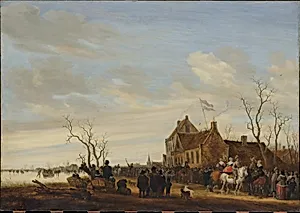
Salomon van Ruysda *Drawing the Eel*, in the early 165s, captures a lively winter village scene from the Dutch Golden Age. oil-on-wood panel29½ × 41¾ in.) depicts men and women gathered in a snowy hamlet, likely engaged in the communal activity suggested by the title—hauling an eel from a frozen waterway. Horses stand nearby, adding to the bustle, while thatched roofs and distant hills evoke the everyday rhythms of 17th-century Dutch rural. As a master of landscape painting, Ruysdael (c. 1602–1670), brother to the renowned Jacob van Ruisdael, blended meticulous realism with atmospheric depth, hallmarks of the Dutch Baroque style. Oil on wood allowed for the fine, glowing details that bring the crisp snow and muted winter light to life, a technique prized for its durability and luminosity in smaller-scale works. Acquired by the Metropolitan Museum of Art in 1871, this painting highlights the cultural fascination with seasonal genre scenes, celebrating community resilience amid Holland's harsh winters. It's a window into a world where simple pleasures and labor intertwined, inviting us to savor the subtle poetry of the ordinary.
About the Artist
Salomon van Ruysdael · 1600–1670
Comment on works: Views; Marines; Still life with dead birds