
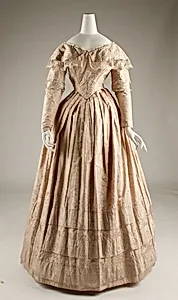
Dress
Unknown Artist
1845–46
Medium
silk
Classification
Dress
Culture
European
Department
Costume Institute
Museum
Metropolitan Museum of Art, New York, NY
Credit
Catharine Breyer Van Bomel Foundation Fund, 1981
Accession Number
1981.210.3
Rights
Public Domain
Art Historical Context
Step into the elegance of mid-19th-century Europe this exquisite silk dress from 1845–46, a highlight of the Metropolitan Museum of Art's Costume Institute. Crafted by an unknown artist, likely a skilled European dressmaker, this garment embodies the opulent fashion of the Romantic era, when women's attire emphasized graceful silhouettes with full skirts supported by layers of petticoats. luxurious silk fabric—prized for its sheen, durability, and ability to hold intricate pleats and folds—signaled wealth and refinement, reserved for the upper classes attending balls, teas, or court events. Silk's significance extended beyond aesthetics; as a labor-intensive textile often imported from Asia via trade routes, it connected wearers to global commerce and craftsmanship. This dress captures a transitional moment before the crinoline's dominance in the 1850s, showcasing the era's focus on soft, voluminous drapery that accentuated the waist. Donated through the Catharine Breyer Van Bomel Foundation Fund in 1981, it offers a tangible glimpse into daily luxury and social rituals of Victorian Europe, reminding us how clothing wove personal identity with cultural history.