
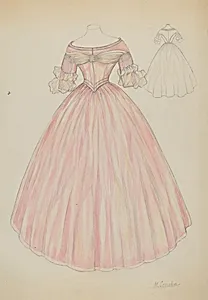
Dress
c. 1936
Medium
watercolor and graphite on paper
Dimensions
overall: 30.5 x 22.6 cm (12 x 8 7/8 in.)
Classification
Index of American Design
Department
CG-W
Museum
National Gallery of Art, Washington, D.C.
Credit
Index of American Design
Accession Number
1943.8.1495
Rights
Public Domain
Art Historical Context
This delicate watercolor and graphite rendering of a dress, created around 1936 by Margaret Concha, belongs to the Index of American Design, a landmark New Deal initiative. Launched by the Works Progress Administration’s Federal Art Project, the Index employed hundreds of artists during the Great Depression to produce a comprehensive visual record of American decorative arts, folk crafts, and everyday objects from the colonial era through the nineteenth century. Concha’s contribution captures a historic garment with the precision demanded by the project, turning documentation into an act of cultural preservation. Watercolor combined with graphite allowed artists to render textures, patterns, and construction details with remarkable accuracy, creating images that could stand in for fragile originals. These works were never intended as personal expression but as scholarly tools—an encyclopedic archive of design that highlighted regional traditions, immigrant influences, and the ingenuity of American makers. By focusing on clothing, Concha’s drawing reminds us how textiles carried social meaning, reflecting status, occasion, and craftsmanship in earlier American life. Today the Index, housed at the National Gallery of Art, offers both aesthetic pleasure and historical insight. It stands as a testament to a moment when the nation chose to value its material heritage even amid economic hardship, ensuring that objects like this dress remain visible to future generations.
About the Artist
Margaret Concha · 1897–1994
Margaret Concha is an artist whose life and career remain incompletely documented in the major scholarly literature on art history. No confirmed birth or death dates have been established, and details of her training, nationality, and primary working period are not reliably recorded in available sources. The works attributed to her suggest engagement with the visual traditions of her era, though ...