
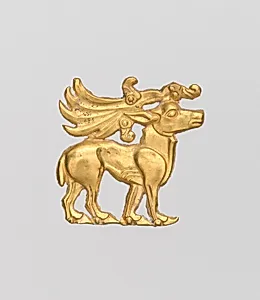
Dress ornament
Unknown Artist
ca. 5th century BCE
Medium
Gold
Dimensions
1 1/8 × 1 1/8 × 1/16 in. (2.9 × 2.9 × 0.2 cm)
Classification
Metalwork-Ornaments
Culture
Scythian
Department
Ancient Near Eastern Art
Museum
Metropolitan Museum of Art, New York, NY
Credit
Fletcher Fund, 1924
Accession Number
24.97.53
Rights
Public Domain
Tags
Art Historical Context
This delicate gold dress ornament, crafted by an unknown Scythian artist the 5th century, exemplifies the nomadic artistry of the Scythians—fierce horse-riding warriors who roamed the vast Eurasian steppes from the Black Sea to Central Asia. Measuring just over an inch square this tiny treasure was likely pinned to clothing or accessories, serving both practical and symbolic purposes in daily life or elite adornment. Scythian goldwork, like this piece from the Metropolitan Museum of Art's Ancient Near Eastern Art collection, highlights their mastery of repoussé and chasing techniques, where thin gold sheets were hammered and incised to create intricate designs. Animal motifs, a hallmark of Scythian "Animal Style," dominate such ornaments, depicting real and fantastical beasts in dynamic, intertwined poses that evoked the wild steppes and spiritual beliefs in animal spirits. Acquired through the Fletcher Fund in 1924, this ornament offers a glimpse into a culture celebrated by ancient Greeks like Herodotus for their opulent burials filled with gold. It underscores the Scythians' role as cultural bridges between East and West, blending Persian influences with steppe innovation in their enduring legacy of portable luxury.