
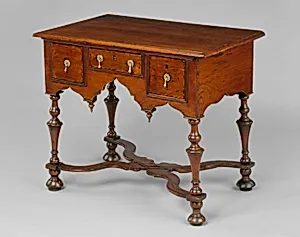
Dressing Table
1700–30
Medium
Walnut with Southern yellow pine, white pine, and white cedar
Dimensions
73.7 × 864 × 54.6 cm (29 × 34 × 21 1/2 in.)
Classification
table
Department
Arts of the Americas
Museum
Art Institute of Chicago
Accession Number
109455
Rights
Public Domain
Art Historical Context
This elegant dressing table, crafted between 1700 and 1730, exemplifies the refined craftsmanship of early colonial America, likely from the British colonies in the Northeast or Mid-Atlantic regions. at about 29 inches high with a compact 34-by-21½-inch footprint, it served as a multifunctional vanity for grooming and storing personal items, reflecting the rising affluence of the merchant class. Such pieces were prized possessions in prosperous households, blending practicality with subtle displays of wealth. Constructed primarily from walnut—a dense, beautifully grained hardwood prized for its durability and rich patina—the table incorporates secondary woods like Southern yellow pine, white pine, and white cedar for structural elements such as drawer bottoms and framing. These regional materials highlight the resourcefulness of colonial cabinetmakers, who sourced local timbers while drawing inspiration from English and Dutch Baroque designs. The unknown artisan's skill in joinery and finishing would have ensured longevity, with walnut's natural oils providing a lustrous surface ideal for polishing. Housed in the Art Institute of Chicago's Arts of the Americas department, this table offers a window into 18th-century domestic life, underscoring the cultural fusion of European traditions and New World ingenuity. Its survival speaks to the enduring legacy of anonymous makers who shaped American furniture as an art form.