
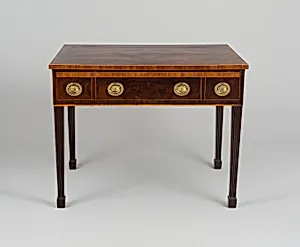
Dressing Table
c. 1790
Medium
Mahogany, satinwood and rosewood veneers, gilt metal and mirror glass
Dimensions
83.8 × 105.4 × 74.3 cm (33 × 41 1/2 × 29 1/4 in.)
Classification
table
Department
Applied Arts of Europe
Museum
Art Institute of Chicago
Accession Number
27118
Rights
Public Domain
Art Historical Context
Step into the refined world of late 18th-century luxury with Thomas Scott's *Dressing Table* (c. 1790), a masterpiece of British cabinetmaking now housed in the Art Institute Chicago's Department of Applied Arts of Europe Crafted from rich mahogany with delicate satinwood and rosewood veneers, 83.8 × 105.4 × 74.3 cm piece features ornate gilt metal mounts and mirror glass, evoking the elegance of a gentleman's or lady's private chamber. Its neoclassical lines and shimmering surfaces reflect the era's fascination with symmetry and classical antiquity, inspired by ancient Greek and Roman motifs. Scott, a skilled London maker, employed advanced veneering techniques—thin slices of exotic woods glued to a solid core—to create intricate patterns and glowing contrasts, a hallmark of high-end Georgian furniture. The use of costly imported woods like satinwood from the West Indies and rosewood from Brazil underscored the table's status as a bespoke commission for the elite, blending functionality with opulent display. This dressing table not only served practical purposes like grooming and storage but symbolized social refinement during the Adam style's heyday. Today, it offers a tactile glimpse into Enlightenment-era domestic life, where beauty and craftsmanship intertwined seamlessly.