
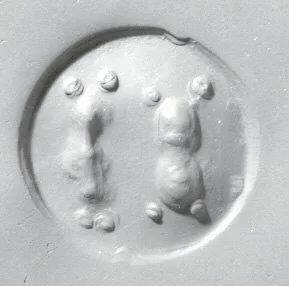
Drilled oval hemispheroid seal
Unknown Artist
ca. 3500–2900 BCE
Medium
Marble, pinkish brown
Dimensions
Seal Face: 2.69 x 2.74 cm Height: 1.08 cm String Hole: 0.4 cm
Classification
Stone-Stamp Seals
Period
Late Uruk–Jemdet Nasr
Department
Ancient Near Eastern Art
Museum
Metropolitan Museum of Art, New York, NY
Credit
Gift of Martin and Sarah Cherkasky, 1985
Accession Number
1985.192.26
Rights
Public Domain
Art Historical Context
This petite drilled oval hemispheroid seal crafted from pinkish brown marble around 3500–2900 BCE, hails from the Late Uruk–emdet Nasr period ancient Mesopotamia. Measuring just 2.69 x 2.74 cm across its face and 1.08 cm high, with a precisely drilled 0.4 cm string hole, it exemplifies the exquisite miniaturization of early stone-working techniques. These seals were likely worn as amulets or used practically, strung for easy transport. Stamp seals like this one mark a pivotal moment in Near Eastern history, bridging prehistoric and early urban societies. In the Uruk and Jemdet Nasr eras—transitional phases toward Sumerian civilization—they served administrative functions, imprinting ownership, contracts, or goods onto soft clay. The hemispheroid shape and oval face allowed for clear, repeatable impressions, showcasing advanced drilling and polishing skills with simple stone tools. Today, this rare artifact graces the Metropolitan Museum of Art's Ancient Near Eastern Art collection, a generous 1985 gift from Martin and Sarah Cherkasky. It invites us to marvel at the ingenuity of anonymous artisans whose tiny creations laid the groundwork for millennia of bureaucratic and artistic traditions.