
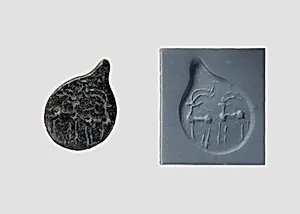
Drop-shaped (tanged) pendant seal and modern impression: quadrupeds
Unknown Artist
ca. 4500–3500 BCE
Medium
Black-green chlorite or steatite
Dimensions
Seal Face: 1.8 x 1.7 cm Height: 0.54 String Hole: 0.2
Classification
Stone-Stamp Seals
Period
Late Ubaid–Middle Gawra
Department
Ancient Near Eastern Art
Museum
Metropolitan Museum of Art, New York, NY
Credit
Purchase, 1893
Accession Number
93.17.122
Rights
Public Domain
Tags
About this artwork
Drop-shaped (tanged) pendant seal and modern impression: quadrupeds by Unknown Artist, ca. 4500–3500 BCE. Created in Black-green chlorite or steatite, this work exemplifies the artistic practices and cultural values of its period. The piece reflects the technical skills and aesthetic sensibilities characteristic of its historical and cultural context. As part of the Ancient Near Eastern Art collection, it contributes to our understanding of artistic development and cultural expression. The work ...
Art Historical Context
This exquisite drop-shaped pendant seal, around 4500–3500 BCE during the Late Ubaid Middle Gawra periods in ancient Mesopotamia, showcases the ingenuity of early Near Eastern artisans. Fashioned from black-green chlor or steatite—a yet durable stone ideal for fine carving—the tiny seal measures just 1.8 x 1.7 cm on its face, with a tanged design and string hole suggesting it doubled as wearable jewelry or an amulet. Acquired by the Metropolitan Museum of Art in 1893, it belongs to the Stone-Stamp Seals collection in Ancient Near Eastern Art. The seal's intaglio surface features quadrupeds—likely stylized animals on four legs—carved in low relief, perfect for creating impressions in clay. These early stamp seals mark a pivotal moment in artistic and administrative history, predating the more famous cylinder seals and hinting at emerging practices for marking ownership, sealing goods, or ritual purposes. The compact scale demanded remarkable precision, reflecting sophisticated stoneworking techniques in a preliterate society. As a "historical document," this artifact illuminates the Ubaid-Gawra culture's fascination with animals, possibly symbolizing fertility, protection, or the natural world. Its modern impression allows us to appreciate the lively motifs, bridging 6,000 years to connect visitors with humanity's ancient creativity.