
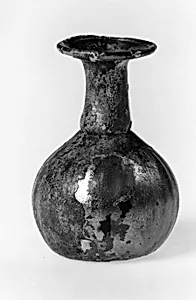
Dropper flask
Unknown Artist
probably 3rd–4th century
Medium
Almost colorless glass. Blown (the body blown in a dip mold), tooled, the rim finished at the furnace.
Dimensions
H. 9.2 cm; diam. of rim 4.4 cm; diam. of body 6.6 cm
Classification
Glass
Culture
Roman
Department
Robert Lehman Collection
Museum
Metropolitan Museum of Art, New York, NY
Credit
Robert Lehman Collection, 1975
Accession Number
1975.1.1584
Rights
Public Domain
Art Historical Context
This delicate Dropper flask, hailing from the Roman world of the 3rd–4th century, offers a glimpse into the everyday ingenuity of late antiquity. Standing just 9.2 cm tall with a slender body (6.6 cm diameter) and narrow rim (4.4 cm), it resides in the Robert Lehman Collection at The Metropolitan Museum of Art.ed by an unknown artisan, its almost colorless glass evokes the clarity prized in Roman luxury goods, blending utility with subtle elegance. The flask's creation showcases advanced glassblowing techniques of the era: the body was blown into a dip mold for precise shaping, then tooled for refinement, with the rim finished directly at the furnace for a smooth edge. These methods, perfected by Roman glassmakers, allowed mass production of high-quality vessels, revolutionizing trade and domestic life across the empire. Likely used for dispensing perfumes, oils, or medicines drop by drop—hence its name—this flask highlights Roman innovation in functional design. Small yet sophisticated, it reflects a culture where glassware was both practical tool and status symbol, bridging art and daily ritual in the waning years of the classical world.