
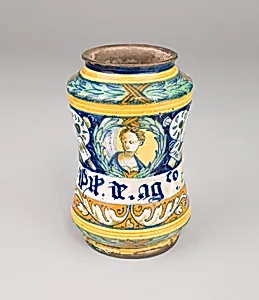
Drug Jar (Albarello)
c. 1550
Medium
Tin-glazed earthenware
Dimensions
H.: 15.6 cm (6 1/8 in.)
Classification
earthenware
Department
Applied Arts of Europe
Museum
Art Institute of Chicago
Accession Number
25354
Rights
Public Domain
Art Historical Context
This elegant Drug Jar, known as an albarello, was crafted around 1550 by the renowned potteries of Castel Durante in Renaissance Italy. Standing just over six inches tall, the cylindrical form was designed for practical use in apothecary shops, where it stored dry herbs, powders, and medicinal compounds. Its tin-glazed earthenware surface, a hallmark of Italian maiolica, provided a smooth white ground ideal for colorful decoration, reflecting the period’s blend of utility and artistry. Castel Durante potteries were celebrated for their refined maiolica techniques, which involved applying a tin-based glaze that allowed vibrant hues to shine after firing. Such jars often featured inscriptions or motifs identifying their contents, underscoring their role in the growing pharmaceutical practices of 16th-century Europe. As part of the Applied Arts of Europe collection at the Art Institute of Chicago, this piece highlights how everyday objects became vehicles for artistic expression during the Renaissance.