
Drunken Asaina
Katsushika Hokusai, ca. 1810
About this artwork
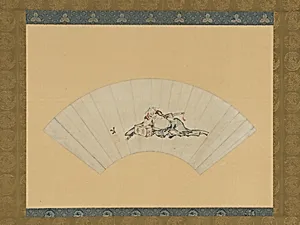
Katsushika Hokusai's *Drunken Asaina*, created around 1810 during Japan's Edo period (1615–1868), captures the playful spirit of ukiyo-e, the "pictures of the floating world" that celebrated everyday life, theater, and fleeting pleasures. Hokusai, one of Japan's most renowned artists, was a master of this vibrant woodblock print and painting tradition, famous for works like *The Great Wave off Kanagawa*. Here, he depicts a drunken male figure—likely inspired by kabuki theater or urban folklore—stumbling in exuberant revelry, embodying the era's fascination with human foibles and festive indulgences. Originally painted on a fan with ink and subtle colors on paper, this intimate artwork (9 7/16 × 20 3/16 in.) was later mounted as a hanging scroll, transforming a portable accessory into a wall-worthy display. Fans were everyday objects in Edo Japan, often adorned with witty scenes for personal enjoyment during hot summers or social gatherings. Hokusai's dynamic brushwork and expressive lines bring the scene to life, highlighting his genius for humor and movement in a compact format. Acquired by the Metropolitan Museum of Art in 1991, *Drunken Asaina* offers a glimpse into Edo society's love for satire and the performing arts, reminding us of art's power to humanize even the most tipsy moments.