
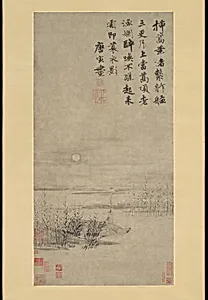
明 唐寅 葦渚醉漁圖 軸|Drunken fisherman by a reed bank
early 16th century
Medium
Hanging scroll; ink on paper
Dimensions
Image: 28 7/16 x 14 9/16 in. (72.2 x 37 cm) Overall with mounting: 64 3/4 x 21 in. (164.5 x 53.3 cm) Overall with knobs: 64 3/4 x 23 3/4 in. (164.5 x 60.3 cm)
Classification
Paintings
Culture & Period
China · Ming dynasty (1368–1644)
Department
Asian Art
Museum
Metropolitan Museum of Art, New York, NY
Credit
Bequest of John M. Crawford Jr., 1988
Accession Number
1989.363.55
Rights
Public Domain
Tags
Art Historical Context
Nestled among the reeds of a serene waterside scene, *Drunken Fisherman by a Reed Bank* a moment of poetic reverie. Created by the celebrated Ming dynasty artist Tang Yin (1470–1523) in the early 16th century, this hanging scroll in ink on paper depicts a lone fisherman lounging tipsily in his boat amid swaying reeds and calm waters. Tang Yin, one of the "Four Masters of the Ming was a scholar-painter from the Wu school, blending, calligraphy, and painting in the literati tradition to evoke harmony with nature. The artwork's sparing use of ink—delicate washes and bold strokes—exemplifies the Wu school's emphasis on personal expression over photorealism. Rather than meticulous detail, Tang evokes a mood of escape and scholarly leisure, themes central to Ming literati culture amid dynastic bureaucracy and social flux. Hanging scrolls like this were treasured for private contemplation, unrolled in intimate settings to inspire reflection. Measuring about 28 by 14 inches in its image area, this piece from the Metropolitan Museum of Art's Asian Art collection highlights the elegance of Chinese ink painting. Donated through the bequest of John M. Crawford Jr. in 1988, it invites visitors to ponder the timeless allure of simplicity and solitude by the water's edge.
About the Artist
Tang Yin · 1470–1524
Talented painter whose career as an official painter was ruined by an examination scandal in 1499. Around 1500 he began to study painting with Zhou chen. He was ultimately considered one of the Four Masters of the Ming, along with Shen Zhou, Wen Zhengming and Qiu Ying.