
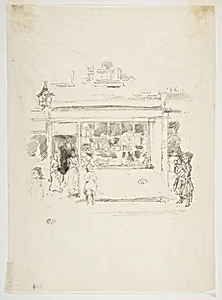
Drury Lane Rags
Medium
Transfer lithograph; only state (Chicago); printed in black ink on cream Japanese paper
Dimensions
Image: 5 13/16 × 6 5/16 in. (14.7 × 16 cm) Sheet: 10 7/8 x 7 7/8 in. (27.6 x 20 cm)
Classification
Prints
Department
Drawings and Prints
Museum
Metropolitan Museum of Art, New York, NY
Credit
Gift of Paul F. Walter, 1984
Accession Number
1984.1119.3
Rights
Public Domain
Tags
Art Historical Context
James McNeill Whistler’s *Drury Lane Rags* (1888) captures the gritty street life of London’s Drury Lane, a bustling theater district shadowed by poverty. Through delicate human figures clad in tattered clothing amid urban buildings, Whistler evokes the stark social contrasts of Victorian England. As a master of the Aesthetic movement, prioritized tonal harmony and subtle atmosphere over narrative detail, transforming everyday scenes into poetic impressions reminiscent of his famous Nocturnes in oil. This transfer lithograph—the only known state printed in Chicago—demonstrates Whistler’s innovative printmaking. He drew the image on transfer paper, which was then pressed onto a lithographic stone for inking and printing on luxurious cream Japanese paper. This medium allowed for velvety blacks and soft edges, emphasizing texture and mood. At just 5 13/16 × 6 5/16 inches, its intimate scale invites close viewing, highlighting Whistler’s influence from Japanese ukiyo-e prints in his choice of paper and flattened composition. Housed in the Metropolitan Museum of Art’s Drawings and Prints department (gift of Paul F. Walter, 1984), this work exemplifies Whistler’s late-1880s lithographic series on London’s underbelly. It offers a window into 19th-century urban realism while celebrating beauty in the mundane—a timeless reminder of art’s power to dignify the overlooked.
About the Artist
James McNeill Whistler · 1834–1903
James Abbott McNeill Whistler (1834-1903) was an American-born painter and printmaker who became a leading figure in the Aesthetic Movement and pioneer of Tonalism and Japonisme. He revolutionized art by championing "art for art's sake" and treating paintings as visual equivalents of musical compositions, titling works as "arrangements," "harmonies," and "nocturnes" to emphasize formal qualities o...