
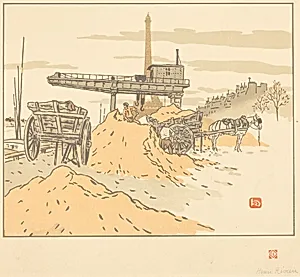
Du Quai de Grenelle
1902
Medium
color lithograph on wove paper
Dimensions
sheet: 22.4 x 27 cm (8 13/16 x 10 5/8 in.)
Classification
Department
CG-E
Museum
National Gallery of Art, Washington, D.C.
Credit
Gift of Frank Anderson Trapp
Accession Number
2003.118.22
Rights
Public Domain
Art Historical Context
Henri Rivière's *Du Quai de Gren* (1902) captures a serene slice of Parisian life along the Seine River in the early 20th century. intimate color lithograph depicts the Quai de Grenelle, working waterfront in Paris's 15th arr, evoking the bustling yet atmospheric urban scenes that defined the Belle Époque. Rivière, a masterful French printmaker influenced by Japanese ukiyo-e artists like Hokusai, infused his works with flattened perspectives, subtle color harmonies, and a poetic sense of place, bridging Impressionism and modernism. Printed on fine wove paper, the medium of color lithography was revolutionary in Rivière's hands. Using multiple lithographic stones—one for each color layer—he achieved delicate, painterly effects akin to watercolor, with vibrant yet nuanced tones that mimic the play of light on water and stone. Measuring just 22.4 x 27 cm, its compact scale invites close contemplation, highlighting the technical precision of hand-pulled prints from this era. Now housed in the National Gallery of Art as a gift from Frank Anderson Trapp, this work exemplifies Rivière's enduring legacy in elevating everyday views into art. It reminds visitors of Paris's romantic industrial edges, where river trade met artistic innovation.
About the Artist
Henri Rivière · 1864–1951
Henri Rivière (1864-1951) stands as a pioneering figure in European printmaking, particularly recognized as the father of color lithography and color woodcut techniques in the West. Born in Paris during the Second Empire, Rivière achieved distinction in two distinct artistic realms: as the creator of innovative shadow theater performances at the legendary Chat Noir cabaret, and as a printmaker who...