
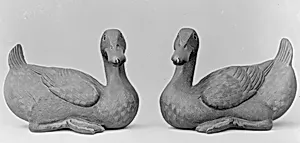
Duck Figure
Unknown Artist
19th century
Medium
Gray stoneware (Bizen ware, Imbe style)
Dimensions
L. 7 in. (17.8 cm)
Classification
Ceramics
Culture & Period
Japan · Edo (1615–1868) or Meiji period (1868–1912)
Department
Asian Art
Museum
Metropolitan Museum of Art, New York, NY
Credit
Gift of Clarence Hoblitzelle, 1908
Accession Number
08.92.2
Rights
Public Domain
Tags
Art Historical Context
Nestled in the Metropolitan Museum of Art's Asian Art collection, this charming Duck Figure exemplifies the timeless artistry of Bizen ware, a renowned Japanese ceramic tradition originating from the Bizen region in Okayama. Crafted in the 19th century during the late Edo (1615–1868) or early Me (1868–1912) period, the sculpture is made from gray stoneware in the Imbe style—a to the pottery heartland of Imbe village. Measuring just 7 inches long, its compact form suggests it was likely a decorative object, perhaps for a scholar's desk or household altar, capturing the duck's plump, lively posture with simple, expressive lines. Bizen ware stands out for its unglazed, high-fired stoneware, produced in wood-firing kilns that reach intense temperatures, allowing natural ash to fuse into subtle, earthy glazes ranging from subtle grays to warm russets. This technique, honed over centuries as one of Japan's Six Ancient Kilns, emphasizes the clay's inherent beauty and durability, reflecting a philosophy of wabi-sabi—embracing imperfection and the passage of time. Ducks, common motifs in Japanese folk art, may symbolize fidelity or seasonal harmony, adding cultural resonance to this anonymous artisan's work. A generous gift to the Met in 1908 by Clarence Hoblitzelle, this piece invites visitors to appreciate the understated elegance of everyday Japanese ceramics, bridging Edo-era craftsmanship with Meiji modernity.