
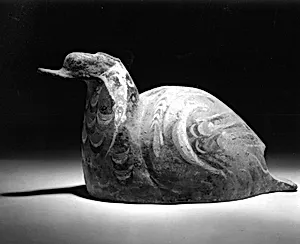
Duck-Shaped Vessel (Zun)
Unknown Artist
2nd–1st century BCE
Medium
Earthenware with pigments
Dimensions
H. 6 5/8 in. (16.8 cm); L. 14 in. (35.6 cm)
Classification
Ceramics
Culture & Period
China · Western Han dynasty (206 B.C.–A.D. 9)
Department
Asian Art
Museum
Metropolitan Museum of Art, New York, NY
Credit
Charlotte C. and John C. Weber Collection, Gift of Charlotte C. and John C. Weber, 1994
Accession Number
1994.605.97
Rights
Public Domain
Tags
Art Historical Context
This charming Duck-Shaped Vessel, or *zun*, hails from China's Western Han dynasty (206.C.–A.D. 9), a golden age of imperial expansion, cultural refinement, and elaborate funerary arts. Crafted from earthenware and vividly enhanced with pigments, it measures a modest 6⅝ inches high and 14 inches long, captures the graceful form of a duck in remarkable detail—from its sleek body and webbed feet to its poised head. Such zoomorphic vessels were prized grave goods, placed in tombs to accompany the deceased into the afterlife, reflecting beliefs in harmony between humans, animals, and the cosmos. As a *zun*, this piece originally served as a ritual wine container, underscoring the Han elite's reverence for ceremonial banquets tied to Confucian rites and ancestor worship. Earthenware, more accessible than bronze, allowed widespread production, with pigments adding lifelike color and symbolism—ducks often evoked water, renewal, and good fortune in ancient Chinese lore. Its naturalistic modeling highlights the era's artistic prowess in capturing animal vitality, blending utility with spiritual purpose. Today, this treasure from the Charlotte C. and John C. Weber Collection graces the Metropolitan Museum of Art's Asian Art galleries, offering a window into Han ingenuity and the enduring allure of nature-inspired design. (198 words)