
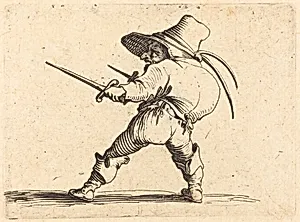
Duellist with Sword and Dagger
c. 1622
Medium
etching and engraving//one of three prints on uncut sheet of Lorrainese paper (1949.5.254.a-c)
Dimensions
plate: 6.3 × 8.5 cm (2 1/2 × 3 3/8 in.) sheet: 18.9 × 17.5 cm (7 7/16 × 6 7/8 in.)
Classification
Department
CG-E
Museum
National Gallery of Art, Washington, D.C.
Credit
Rosenwald Collection
Accession Number
1949.5.254.b
Rights
Public Domain
Art Historical Context
Step into the thrilling world of 17th-century dueling with Jacques Callot *Duellist with Sword and Dagger* (c. 1622), a masterful etching and engraving from National Gallery of Art'swald Collection. This diminutive print—one of three on an uncut sheet of rare Lorrainese paper hailing from Callot's native Lorraine region—measures just 6.3 × 8.5 cm on the plate yet bursts with intricate detail. Callot, a Baroque printmaking genius, captured the poised intensity of a swordsman armed with rapier and parrying dagger, evoking the chivalric yet deadly culture of European nobility. Callot's revolutionary technique blended etching's fluid lines with engraving's precision, allowing him to produce affordable, highly detailed images in series for wide distribution. This sheet's uncut state offers a rare glimpse into the printmaker's workshop process, where multiple images were pulled from a single plate before trimming. Active amid the Thirty Years' War's chaos, Callot often depicted soldiers and combatants, blending realism with theatrical flair—here, the duellist's dynamic stance reflects both martial training and stage-like drama popular in his era. As part of the Prints department (CG-E), this work highlights Callot's influence on later artists like Rembrandt, showcasing how small-scale prints democratized art and preserved fleeting moments of human conflict and valor.
About the Artist
Jacques Callot · 1592–1635
Jacques Callot (1592–1635) was a French printmaker and draftsman from the Duchy of Lorraine, widely regarded as one of the first great artists to practice the graphic arts exclusively. His more than 1,400 etchings chronicled the breadth of 17th-century life, from Medici court festivities to the brutal realities of warfare. Callot revolutionized etching through technical innovations including the é...