
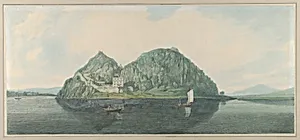
Dumbarton Rock from the South
1788
Medium
Pen and gray ink and watercolor
Dimensions
Sheet: 15 1/16 × 26 7/8 in. (38.3 × 68.3 cm)
Classification
Drawings
Department
Drawings and Prints
Museum
Metropolitan Museum of Art, New York, NY
Credit
Purchase, Raymond Lifchez Living Trust Gift, 2014
Accession Number
2014.148
Rights
Public Domain
Tags
Art Historical Context
Joseph Farington's *Dumbarton Rock from the South* (1788) captures the majestic volcanic plug rising dramatically from the River Clyde in Scotland, a site steeped in history as the location of Dumbarton Castle. Viewed from the south, this expansive watercolor landscape includes quaint houses along the waterfront, scattered boats on the water, and the rolling terrain that defines Scotland's western lowlands. Created during Farington's sketching tour of Scotland, it reflects the late 18th-century British fascination with native scenery, blending topographic precision with a sense of place amid the Romantic era's growing appreciation for the sublime. Rendered in pen and gray ink with watercolor on a generous sheet (15 1/16 × 26 7/8 in.), Farington's technique shines through fine, meticulous lines that delineate architecture and natural forms, enhanced by subtle gray washes for depth and atmosphere. As a Royal Academician renowned for his detailed landscapes, he elevated topographical art from mere documentation to evocative studies, preserving views that might otherwise fade from memory. Today, this work resides in the Metropolitan Museum of Art's Drawings and Prints department, a 2014 gift from the Raymond Lifchez Living Trust. It invites visitors to ponder Scotland's rugged beauty through an artist's discerning eye, bridging 18th-century exploration with our modern gaze.