
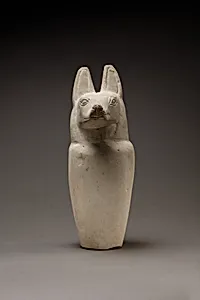
Dummy canopic jar with jackal head
Unknown Artist
ca. 1070–664 BC
Medium
Limestone
Dimensions
H. 30 × W. 11.2 × D. 15.8 cm (11 13/16 × 4 7/16 × 6 1/4 in.)
Classification
Canopic jar, jackal, dummy jar
Period
Third Intermediate Period
Department
Egyptian Art
Museum
Metropolitan Museum of Art, New York, NY
Credit
Rogers Fund, 1928
Accession Number
28.3.60
Rights
Public Domain
Tags
Art Historical Context
This intriguing limestone "Dummy canopic jar with jackal" hails from Egypt's Third Intermediate Period (ca.1070–664 BC), a time of political fragmentation following the grandeur of the New Kingdom.opic jars were vital in ancient Egyptian burial rituals, housing the viscera removed during mummification—protected by the four sons of Horus. The jackal head here evokes Duamutef, guardian of the stomach, or perhaps Anubis, theal-headed god of embalming, symbolizing vigilance over the afterlife journey. Carved from limestone, a durable yet workable stone favored for funerary objects, this dummy jar—measuring about 30 cm tall—is a non-functional model, likely placed in a tomb to invoke protective powers without practical use. Its simplified form reflects the period's artistic shift toward less monumental styles amid regional dynasties, blending continuity of Old Kingdom traditions with subtle innovations. Acquired through the Rogers Fund in 1928 and now in the Metropolitan Museum of Art's Egyptian Art collection, this piece offers a window into everyday sacred practices, reminding us how Egyptians meticulously prepared for eternity through symbolic artistry.