
Duncan Phyfe Sofa
c. 1937
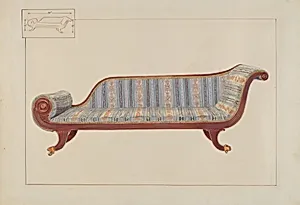
Medium
watercolor, gouache, colored pencil, pen and ink, and graphite on paper
Dimensions
overall: 22.9 x 30.4 cm (9 x 11 15/16 in.) Original IAD Object: 90"long; 27"deep; 33"high at highest end. See d.s. for dets.
Classification
Index of American Design
Department
CG-W
Museum
National Gallery of Art, Washington, D.C.
Credit
Index of American Design
Accession Number
1943.8.5909
Rights
Public Domain
Art Historical Context
Behold the *Duncan Phyfe Sofa*, meticulously rendered watercolor depiction by artist Edward L. Loper created around 1937. This work on paper—measuring 22.9 x 30.4 cm—captures the elegance of a classic American furniture piece through layers of watercolor, gouache colored pencil, pen and ink, and graphite. of the National Gallery of Art's Index of American collection, it documents an original sofa measuring 90 inches long, 27 inches, and 33 inches at its tallest point, showcasing Loper's skill in translating three-dimensional form into precise, colorful detail. Produced under the Federal Art Project of the Works Progress Administration (WPA) during the Great Depression, the Index of American Design employed artists like Loper to celebrate everyday American craftsmanship. This initiative preserved the nation's decorative arts heritage amid economic hardship, ensuring styles like Duncan Phyfe's neoclassical furniture—known for its graceful curves, carved motifs, and refined proportions—endured for future generations. Loper's mixed-media technique highlights the sofa's luxurious upholstery and structural finesse, inviting viewers to appreciate how 19th-century designs blended European influences with American ingenuity. A testament to cultural resilience, this artwork bridges art and design history, reminding us of the enduring beauty in our shared past.
About the Artist
Edward L. Loper · 1916–2011
Edward Leroy Loper Sr. was born on April 7, 1916, in Wilmington, Delaware, to a poor family in the racially mixed Frogtown neighborhood, where he was raised primarily by his maternal grandmother. After graduating from Howard High School, the only secondary school available to African Americans in Delaware at the time, Loper received no formal artistic training initially but immersed himself in sel...