
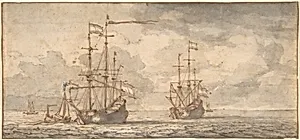
Dutch Ships at Anchor
mid-17th–early 18th century
Medium
Pen and brown ink, brush and gray wash, over black chalk
Dimensions
sheet: 3 7/8 x 8 1/2 in. (9.8 x 21.6 cm)
Classification
Drawings
Department
Drawings and Prints
Museum
Metropolitan Museum of Art, New York, NY
Credit
From the Collection of Rita and Frits Markus, Bequest of Rita Markus, 2005
Accession Number
2005.330.10
Rights
Public Domain
Tags
Art Historical Context
Willem van de Velde II, one of the foremost marine artists of the Dutch Golden Age, created this delicate drawing of ships at anchor during a period when the Netherlands dominated global trade and naval power. Working in the mid-17th to early 18th century, van de Velde specialized in capturing the intricate details of vessels, from rigging to hulls, reflecting the era’s pride in maritime strength and technological achievement. Such scenes often served both as records of actual fleets and as studies for larger paintings commissioned by naval patrons. Executed in pen and brown ink with gray wash over black chalk, the drawing showcases van de Velde’s masterful technique for suggesting light, shadow, and water’s surface on a remarkably small scale—just under four by nine inches. This medium allowed him to combine precise line work with soft tonal washes, evoking the quiet stillness of anchored ships while demonstrating his keen observational skills. Many of his drawings functioned as preparatory works or independent pieces valued for their documentary accuracy. Housed in the Metropolitan Museum of Art’s collection of drawings and prints, “Dutch Ships at Anchor” offers visitors an intimate glimpse into 17th-century Dutch seafaring culture and the refined draftsmanship that made van de Velde a favorite among European courts.