
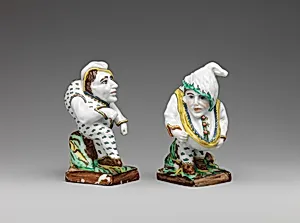
Dwarf (one of a pair)
ca. 1740–45
Medium
Tin-glazed soft-paste porcelain decorated in polychrome enamels
Dimensions
Overall (confirmed): 4 5/8 x 2 1/8 x 2 15/16 in. (11.7 x 5.4 x 7.5 cm)
Classification
Ceramics-Porcelain
Culture
French, Villeroy
Department
European Sculpture and Decorative Arts
Museum
Metropolitan Museum of Art, New York, NY
Credit
The Jack and Belle Linsky Collection, 1982
Accession Number
1982.60.276
Rights
Public Domain
Tags
Art Historical Context
This charming porcelain figurine, titled *Dwarf (one of a pair)*, hails from the Villeroy factory in France around 1740–45, during the exuberant Rococo era. Attributed to designs inspired by the renowned etcher Jacques Callot, whose whimsical depictions of dwarfs and commedia dell'arte characters captivated Europe in the 17th century, this piece exemplifies how 18th-century porcelain makers revived earlier artistic motifs in three dimensions. Crafted from tin-glazed soft-paste porcelain—a delicate French innovation blending clay, glass frit, and tin oxide for opacity and sheen—it stands just 4⅝ inches tall, perfect for mantelpieces or cabinet displays. The figurine's lively polychrome enamel decoration brings the dwarf to life with vibrant colors, capturing exaggerated features and playful attire typical of grotesque or fantastical figures popular in decorative arts. Villeroy, known for accessible yet refined ceramics, produced such pairs to adorn bourgeois homes, blending sculpture and ornament. This example, from The Jack and Belle Linsky Collection at The Metropolitan Museum of Art, highlights the technical prowess of soft-paste porcelain before Sèvres dominated the field, offering a window into 18th-century French taste for the fanciful and intimate.
About the Artist
Jacques Callot|Villeroy · 1592–1635
Jacques Callot (1592–1635) was a French printmaker and draftsman from the Duchy of Lorraine, widely regarded as one of the first great artists to practice the graphic arts exclusively. His more than 1,400 etchings chronicled the breadth of 17th-century life, from Medici court festivities to the brutal realities of warfare. Callot revolutionized etching through technical innovations including the é...