
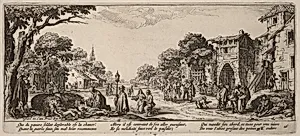
Dying Soldiers by the Roadside
c. 1642/1680
Medium
etching and engraving on laid paper
Dimensions
plate: 8.2 × 18.4 cm (3 1/4 × 7 1/4 in.) sheet (irreg.): 18 × 29 cm (7 1/16 × 11 7/16 in.)
Classification
Department
CG-E
Museum
National Gallery of Art, Washington, D.C.
Credit
Ailsa Mellon Bruce Fund
Accession Number
1974.55.60
Rights
Public Domain
Art Historical Context
**Dying Soldiers by theside** is a poignant etching and engraving Dutch artist Gerrit vanagen, created after the influential French printmaker Jacques Callot around 1642–1680. Callot, renowned for his masterful small-scale etchings documenting the horrors of the Thirty Years' War (1618–1648), this original as part of his seminal series *The Miseries and Misfort of War*. Schagen's faithful reproduction captures the grim reality of battlefield aftermath, showing fallen soldiers abandoned by a roadside amid a landscape of devastation—a stark commentary on war's human toll. The print's modest plate size (8.2 × 18.4 cm) belies its technical brilliance. Callot pioneered intricate etching techniques, using fine needles to incise acid-resistant grounds on metal plates, allowing for extraordinary detail in facial expressions, tattered uniforms, and chaotic compositions. Schagen enhanced this with engraving, adding depth and precision on laid paper, a period staple prized for its texture. This combination made such prints affordable yet impactful, disseminating anti-war messages across Europe. Housed in the National Gallery of Art (Ailsa Mellon Bruce Fund), this work exemplifies 17th-century printmaking's power to evoke empathy. Visitors will appreciate its unflinching realism, a precursor to later war art, reminding us of art's role in bearing witness to history's tragedies.