
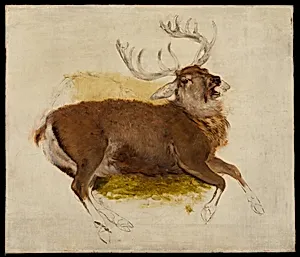
Dying Stag
ca. 1830
Medium
Oil on canvas
Dimensions
18 1/16 × 21 1/16 in. (45.9 × 53.5 cm)
Classification
Paintings
Department
European Paintings
Museum
Metropolitan Museum of Art, New York, NY
Credit
Gift of the Eugene V. and Clare E. Thaw Charitable Trust, 2018
Accession Number
2018.289.5
Rights
Public Domain
Tags
Art Historical Context
Sir Edwin Henry Landseer, a leading British artist of the Victorian era, was renowned for his masterful depictions of animals, blending Romantic sentiment with hyper-realistic detail. *Dying Stag*, created around 1830, exemplifies his signature style in oil on canvas—a medium that allowed him to render the deer's lustrous fur, subtle musculature, and poignant expression with luminous precision. At just over 18 by 21 inches, this intimate-scale painting invites close contemplation, drawing viewers into the stag's final moments amid a natural wilderness. Landseer's works often anthropomorphized animals, evoking human-like nobility and pathos, which resonated deeply in 19th-century Britain amid growing fascination with nature's sublime beauty and the hunt's drama. This piece reflects the Romantic movement's emphasis on emotion and the transient cycle of life, themes that captivated Queen Victoria, a devoted patron who knighted Landseer in 1850. Now a cherished gift to the Metropolitan Museum of Art's European Paintings collection, *Dying Stag* captures timeless empathy for the wild, reminding us of art's power to humanize the untamed world.