
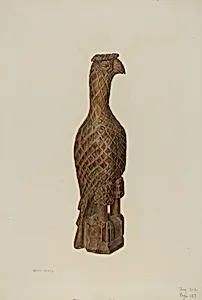
Eagle
c. 1941
Medium
watercolor, pen and ink, and graphite on paperboard
Dimensions
overall: 43.9 x 30.4 cm (17 5/16 x 11 15/16 in.) Original IAD Object: 2 5/8" wide; 2 5/8" deep; 10 3/4" high
Classification
Index of American Design
Department
CG-W
Museum
National Gallery of Art, Washington, D.C.
Credit
Index of American Design
Accession Number
1943.8.17091
Rights
Public Domain
Art Historical Context
**Eagle**, a meticulous rendering by artist Hester Duany around 1941, captures the majesty of a small American folk art sculpture—measuring just 2⅝ inches wide and deep, and 10¾ inches high. Created as part of the Index of American Design (IAD), this work showcases Duany's skill in watercolor, pen and ink, and graphite on paperboard, blending vibrant color with fine lines to highlight the eagle's intricate carving, feathers, and symbolic form. At 43.9 x 30.4 cm, the drawing faithfully reproduces the object's details, evoking the craftsmanship of early American decorative arts. The IAD, a Federal Art Project under the Works Progress Administration during the Great Depression, commissioned artists like Duany to document the nation's folk heritage through precise, museum-quality renderings. This effort preserved everyday objects—often eagles symbolizing patriotism and freedom—from weathervanes to ship figureheads, safeguarding cultural treasures amid economic hardship. Housed in the National Gallery of Art's collection, **Eagle** exemplifies how such works bridged art and history, making intangible stories accessible. Today, it invites visitors to appreciate the eagle's enduring role in American iconography, rendered with a technique that balances realism and artistry for timeless appeal.
About the Artist
Hester Duany · 1891–1964
Hester Duany (1891–1964) was an American artist best known for her meticulous renderings of traditional American folk art objects as part of the Index of American Design, a Federal Art Project under the Works Progress Administration (WPA) from 1935 to 1942. Working out of the New York City Project, Duany contributed dozens of watercolor and graphite drawings on paperboard that captured the intrica...