
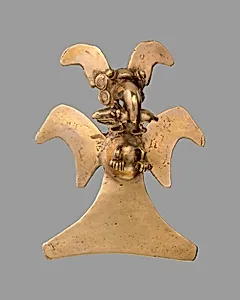
Eagle Pendant
Unknown Artist
11th–16th century
Medium
Gold (cast alloy)
Dimensions
H. 5 1/2 × W. 4 1/8 × D. 2 in. (14 × 10.5 × 5.1 cm)
Classification
Metal-Ornaments
Culture
Chiriqui
Department
Arts of Africa, Oceania, and the Americas
Museum
Metropolitan Museum of Art, New York, NY
Credit
The Michael C. Rockefeller Memorial Collection, Bequest of Nelson A. Rockefeller, 1979
Accession Number
1979.206.906
Rights
Public Domain
Tags
Art Historical Context
This exquisite Eagle Pendant, crafted by an unknown artist of the Chiriquí culture in what is now Panama between the 11th and 16th centuries, exemplifies pre-Columbian mastery of goldworking in the Americas. Measuring just 5½ inches high, this cast gold alloy ornament likely adorned elite individuals, symbolizing power and prestige. The Chiriquí people, flourishing along Panama's Pacific coast, were renowned for intricate metalwork, which blended artistry with spiritual beliefs—eagles, as raptors, often evoked celestial forces or elite status in their worldview. The pendant's creation via lost-wax casting—a sophisticated technique involving sculpting a wax model, encasing it in clay, and pouring molten gold—allowed for its dynamic, three-dimensional form, complete with spread wings and a commanding presence. This method highlights the Chiriquí's technical prowess, producing lightweight yet durable jewelry that could be worn or suspended. Such ornaments were not mere decoration but cultural treasures, reflecting social hierarchies and connections to the natural and supernatural worlds. Today, housed in The Metropolitan Museum of Art as part of The Michael C. Rockefeller Memorial Collection, this pendant invites us to marvel at the enduring legacy of Chiriquí artisans, whose goldwork bridged everyday life and the divine. (198 words)