
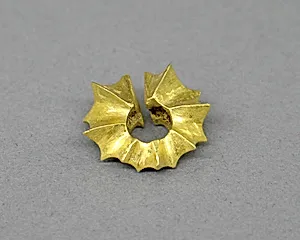
Ear Clip in the Shape of a Starfruit
Unknown Artist
Second half of the 8th–second half of the 10th century
Medium
Gold
Dimensions
H. 3/16 in. (0.5 cm); Diam. 5/16 in. (0.8 cm)
Classification
Jewelry
Culture & Period
Indonesia (Java) · Central Javanese period
Department
Asian Art
Museum
Metropolitan Museum of Art, New York, NY
Credit
The Samuel Eilenberg-Jonathan P. Rosen Collection of Indonesian Gold, Bequest of Samuel Eilenberg and Gift of Jonathan P. Rosen, 1998
Accession Number
1998.544.116
Rights
Public Domain
Art Historical Context
This exquisite gold ear clip, shaped like a starfruit (ambola), hails from Java, Indonesia, during the Central Javanese periodsecond half of the 8th to half of the 10 century). This era marked the flourishing of powerful Hindu-Buddhist, such as the Sailendra andaram dynasties, renowned for monumental temples like Borobudur Prambanan. Goldsmiths crafted such finery for the elite, reflecting the region's advanced metallurgy and trade networks that supplied precious gold. Remarkably tiny—standing just 0.5 cm high and 0.8 cm in diameter—this piece showcases the precision of ancient Javanese artisans. Hammered and formed from solid gold, it mimics the starfruit's distinctive ridged, five-pointed silhouette, evoking Java's tropical bounty. Worn as an earring, it would have signified wealth, status, and perhaps spiritual protection, common in Southeast Asian adornments from elite burials or hoards. Now in the Metropolitan Museum of Art's Asian Art collection, thanks to the Samuel Eilenberg-Jonathan P. Rosen bequest, this ear clip offers a glimpse into everyday luxury amid Java's golden age of art and culture.