
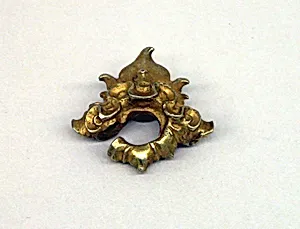
Ear Ornament
Unknown Artist
Second half of the 8th–second half of the 10th century
Medium
Gold
Dimensions
H. 3/4 in. (1.9 cm)
Classification
Jewelry
Culture & Period
Indonesia (Java) · Central Javanese period
Department
Asian Art
Museum
Metropolitan Museum of Art, New York, NY
Credit
The Samuel Eilenberg-Jonathan P. Rosen Collection of Indonesian Gold, Bequest of Samuel Eilenberg and Gift of Jonathan P. Rosen, 1998
Accession Number
1998.544.142
Rights
Public Domain
Art Historical Context
This delicate gold ear ornament, hailing from Java, Indonesia, during the Central Javan period (second half of the 8th to second half of the10th century), exemplifies exquisite craftsmanship of ancient Southeast Asian elites. Measuring just 3/4 inch (1.9 cm) in height, its petite scale belies its cultural weight, designed to adorn the ears of high-status individuals in a society renowned for monumental Hindu-Buddhist like Borobudur and Prambanan. Gold, a precious medium symbolizing wealth, divinity, and eternal purity, was reserved for royalty and nobility in early Java. Artisans likely employed sophisticated techniques such as hammering and granulation to create intricate forms, reflecting the period's fusion of Indian artistic influences with local ingenuity. Such jewelry served not only as personal adornment but also as talismans, underscoring social hierarchy and spiritual beliefs in a thriving kingdom era. Today, this piece from The Samuel Eilenberg-Jonathan P. Rosen Collection at The Metropolitan Museum of Art offers a intimate glimpse into Javanese opulence, reminding us how everyday luxuries illuminated ancient lives.