
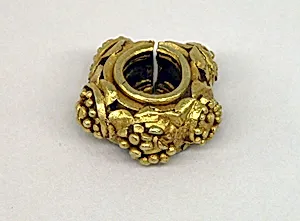
Ear Ornament
Unknown Artist
Second half of the 8th–second half of the 10th century
Medium
Gold
Dimensions
H. 3/8 in. (0.9 cm); Diam. 9/16 in. (1.4 cm)
Classification
Jewelry
Culture & Period
Indonesia (Java) · Central Javanese period
Department
Asian Art
Museum
Metropolitan Museum of Art, New York, NY
Credit
The Samuel Eilenberg-Jonathan P. Rosen Collection of Indonesian Gold, Bequest of Samuel Eilenberg and Gift of Jonathan P. Rosen, 1998
Accession Number
1998.544.166
Rights
Public Domain
Art Historical Context
This delicate gold ear ornament, hailing from Java, Indonesia, during the Central Javanese periodsecond half of the th to second half of the 10th), exemplifies the refined artistry of ancient Southeast Asian elites. Measuring just 3/8 inch high and 9/16 inch in diameter, its diminutive scale belies its cultural weight, crafted for personal adornment in a time when grand Hindu-Buddhist kingdoms the Sailendras and Matarams flourished, building iconic temples such as Borob and Prambanan. Gold, a precious medium symbolizing wealth, power, and divine favor, was meticulously worked into jewelry that signified high social status. Worn likely by nobility or royalty, such ornaments reflect advanced metallurgical skills in the region, where goldsmiths transformed raw metal into symbols of prosperity amid a vibrant era of trade, religion, and artistic innovation. Now part of The Metropolitan Museum of Art's Asian Art collection, thanks to the Samuel Eilenberg-Jonathan P. Rosen bequest, this piece offers a intimate glimpse into Javanese daily luxury. Though the artist remains unknown, its survival underscores the enduring allure of Central Javanese craftsmanship, bridging the monumental and the personal in Indonesia's golden age.