
Ear Spool
Unknown Artist
100 BCE–800 CE
Medium
Hammered gold
Dimensions
H. 2 1/4 × W. 2 1/2 × D. 2 1/2 in. (5.7 × 6.4 × 6.4 cm)
Classification
Metal-Ornaments
Culture
Calima-Yotoco
Department
Arts of Africa, Oceania, and the Americas
Museum
Metropolitan Museum of Art, New York, NY
Credit
Jan Mitchell and Sons Collection, Gift of Jan Mitchell, 1991
Accession Number
1991.419.42
Rights
Public Domain
Art Historical Context
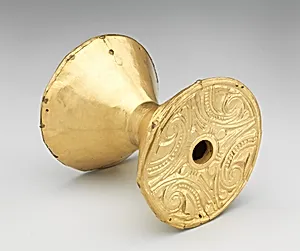
This exquisite **Ear Spool**, crafted by an unknown artist of the Calima-Yot culture between 100 BCE and 800 CE, exemplifies the masterful goldworking traditions of ancient Colombia's Cauca Valley region. Belonging to the pre-Columbian Americas, these ornaments were worn as large earrings by elite members of society, signaling wealth, status, and spiritual power. Measuring just over 2 inches in height, width, and depth, compact form belies its cultural weight, now housed in the Metropolitan Museum of Art's Arts of Africa, Oceania, and the Americas department as part of the Jan Mitchell Collection (gift of 1991). Hammered from thin sheets of gold, the spool showcases sophisticated metallurgical techniques honed over centuries by Calima-Yotoco artisans. Gold, revered as a divine metal linking the earthly and supernatural realms, was meticulously shaped without modern tools—likely using stone hammers and wooden stakes—to create a lightweight yet durable piece. Such ear spools, often paired, stretched earlobes dramatically, embodying ideals of beauty and hierarchy in these thriving communities. Visitors will appreciate how this artifact bridges art and anthropology, offering a tangible glimpse into a vibrant society where adornment was both personal expression and social statement. Its gleaming surface still evokes the sun's life-giving warmth central to Andean cosmologies.