
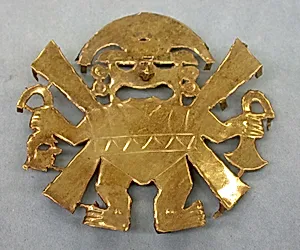
Earflare Frontal
Unknown Artist
6th–7th century
Medium
Gold
Dimensions
Diam. 3 3/8 in. (8.6 cm)
Classification
Metal-Ornaments
Culture
Moche
Department
Arts of Africa, Oceania, and the Americas
Museum
Metropolitan Museum of Art, New York, NY
Credit
The Michael C. Rockefeller Memorial Collection, Bequest of Nelson A. Rockefeller, 1979
Accession Number
1979.206.1244
Rights
Public Domain
Tags
Art Historical Context
This exquisite *Earflare Frontal*, crafted by an unknown Moche artist in the 6th–7th century, hails from the ancient Moche culture of Peru's northern coast. Measuring 3 3/8 inches (8.6 cm) in diameter this gold ornament served as the decorative front of a large earspool, a hallmark of elite status among Moche nobility. Worn by high-ranking individuals, such pieces underscored social hierarchy in a society celebrated for its sophisticated metallurgy and vivid iconography. Moche goldsmiths mastered techniques like lost-wax casting and depletion gilding to create shimmering, intricate designs, transforming raw metal into symbols of power and divinity. The frontals often featured stylized human figures—likely warriors, deities, or sacrificial victims—echoing the culture's ceramic and textile motifs that blended human and supernatural realms. This piece exemplifies the Moche's artistic prowess, where jewelry was not mere adornment but a narrative medium conveying cosmology and ritual. Today, housed in The Metropolitan Museum of Art's Arts of Africa, Oceania, and the Americas department through the Michael C. Rockefeller Memorial Collection, it offers a window into pre-Inca Andean life. Imagine the gleam of gold catching sunlight during ceremonies— a testament to enduring Moche ingenuity.