
Early Spring
1750–1835
Medium
Woodblock print (surimono); ink and color on paper
Dimensions
8 3/16 x 7 7/16 in. (20.8 x 18.9 cm)
Classification
Prints
Culture & Period
Japan · Edo period (1615–1868)
Department
Asian Art
Museum
Metropolitan Museum of Art, New York, NY
Credit
Henry L. Phillips Collection, Bequest of Henry L. Phillips, 1939
Accession Number
JP3004
Rights
Public Domain
Tags
Art Historical Context
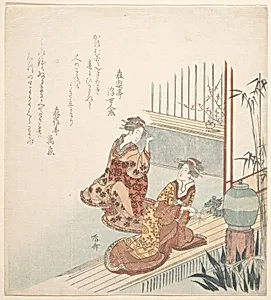
In this woodblock print, two women in richly patterned kimonos sit on a wooden veranda. One rests her hand near her cheek while gazing outward; the other leans forward with a sprig of greenery. A large ceramic vessel, slender bamboo stalks, and delicate flowering branches frame the scene against a pale background, with graceful lines of Japanese calligraphy filling the upper left. Soft washes of ink and color define the flowing robes and architectural details with delicate precision. Ryūryūkyo Shinsai created this surimono during Japan’s Edo period. Surimono were privately commissioned woodblock prints, often combining images with poetry, and were printed in limited numbers using refined techniques on fine paper. The artist’s lifespan is recorded as 1750–1835, placing the work within a time when such prints celebrated seasonal themes and elegant subjects. Titled *Early Spring*, the print belongs to the Metropolitan Museum of Art’s Asian Art collection. It captures the refined aesthetic of its era through careful observation of costume, setting, and natural motifs.
About the Artist
Ryūryūkyo Shinsai · 1799–1823
Ryūryūkyo Shinsai (柳々居辰斎), active from 1799 to 1823, was a prominent Japanese ukiyo-e printmaker based in Edo (modern Tokyo), renowned for his mastery of surimono—luxurious, privately commissioned woodblock prints produced for elite poetry circles and New Year's celebrations. He began his training under Tawaraya Sōri before becoming a student of the legendary Katsushika Hokusai, from whom he recei...