
Earring
Unknown Artist
5th–4th century BCE
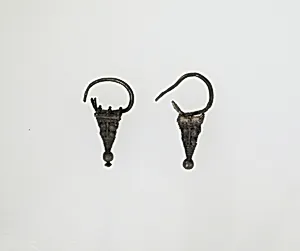
Medium
Silver
Dimensions
Other (.44): 1/2 × 1/4 × 7/8 in. (1.3 × 0.7 × 2.3 cm) Other (.45 body): 1/4 × 1/4 × 9/16 in. (0.7 × 0.7 × 1.4 cm) Diameter (.45 loop): 7/16 × 1/8 × 9/16 in. (1.1 × 0.3 × 1.4 cm)
Classification
Gold and Silver
Period
Classical
Department
Greek and Roman Art
Museum
Metropolitan Museum of Art, New York, NY
Credit
Fletcher Fund, 1924
Accession Number
24.97.44, .45
Rights
Public Domain
Art Historical Context
This delicate silver earring, dating to the 5th–4th century BCE hails from Classical Greece—a golden age of philosophy, democracy, and unparalleled artistry in Athens and beyond. Crafted during a time when jewelry symbolized status, beauty, and sometimes divine favor, it exemplifies the exquisite metalworking techniques of ancient Greek artisans. Though tiny—measuring just 1/2 × 1/4 × 7/8 inches for its main element—the piece reveals sophisticated construction, with a separate body and loop component showcasing precision soldering and forming in silver, a precious metal often reserved for elite adornment. Earrings like this were typically worn by women, suspended from the earlobe and possibly paired with others for symmetry, enhancing elaborate hairstyles at symposia or festivals. Its survival speaks to the durability of Greek craftsmanship and the cultural reverence for personal ornamentation, which bridged everyday life and ritual. Acquired through the Fletcher Fund in 1924, this artifact now graces the Metropolitan Museum of Art's Greek and Roman collection, offering a intimate glimpse into the refined tastes of antiquity. (178 words)