
Earring
Unknown Artist
11th–13th century
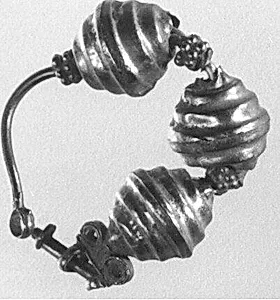
Medium
Gold, fabricated from sheets and granules
Dimensions
Ht. 13/16 in. (2 cm) W. 9/16 in. (1.5 cm) D. 3/8 in. (1 cm)
Classification
Jewelry
Department
Islamic Art
Museum
Metropolitan Museum of Art, New York, NY
Credit
Bequest of Lester Wolfe, 1983
Accession Number
1984.175.46
Rights
Public Domain
Tags
Art Historical Context
This delicate gold earring, crafted between the 11th and 13th centuries, exemplifies exquisite jewelry traditions of the Islamic world. Measuring just under an inch in height, width, and depth, it was meticulously fabricated from thin gold sheets adorned with tiny granules—small spheres of gold expertly fused to the surface. This granulation technique, a hallmark skilled metalworking, created a shimmering, textured effect that caught the light, highlighting the artisan's precision and mastery of fine-scale decoration. In the medieval Islamic courts and bustling trade centers from North Africa to Central Asia, such earrings held both aesthetic and social significance. Worn by men and women alike, they symbolized wealth, status, and cultural refinement, often exchanged as gifts or heirlooms. The use of pure gold reflected the era's advanced goldsmithing, influenced by cross-cultural exchanges along the Silk Roads. Though the artist remains unknown, this piece speaks to the anonymous brilliance of Islamic craftsmen whose innovations in jewelry endured for centuries. Today, this treasure from the Metropolitan Museum of Art's Islamic Art collection, bequeathed by Lester Wolfe in 1983, invites us to marvel at the artistry of everyday adornment turned eternal.