
Earring
Unknown Artist
6th–7th century
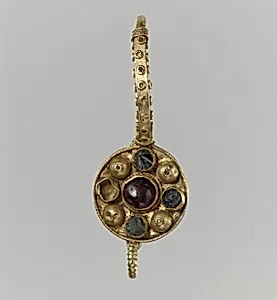
Medium
Gold, garnet, glass; inlays are possible restorations
Dimensions
Overall: 1 9/16 x 9/16 x 11/16 in. (4 x 1.5 x 1.7 cm) hoop: 13/16 in. (2 cm) basket: 7/8 x 9/16 x 3/8 in. (2.3 x 1.5 x 0.9 cm)
Classification
Metalwork-Gold
Culture
Langobardic or Byzantine (?)
Department
Medieval Art
Museum
Metropolitan Museum of Art, New York, NY
Credit
Gift of J. Pierpont Morgan, 1917
Accession Number
17.191.10
Rights
Public Domain
Art Historical Context
This delicate gold earring, dating to the 6th–7th century, hails from the turbulent era following the fall of the Roman in Italy. Crafted by an unknown artist, it may reflect Langobardic (Lombard) influences—linked to the Germanic Lombards who established a kingdom in northern Italy—or Byzantine artistry from the Eastern Roman Empire, whose opulent styles spread westward. Its small scale (just under 2 cm across) belies its status as a luxury item, likely worn by elite women as a symbol of wealth and cultural fusion. Fashioned from gold with vibrant garnet and glass inlays, the earring features a hoop and ornate basket design, showcasing advanced early medieval metalworking techniques. The inlays, possibly restored, highlight the era's cloisonné-like methods, where gemstones were set into gold cells for dazzling color and light play. Such jewelry bridged pagan and Christian worlds, blending barbarian craftsmanship with imperial sophistication. A generous gift to the Metropolitan Museum of Art from J. Pierpont Morgan in 1917, this piece invites us to ponder the lives of its long-ago wearers—amid invasions and migrations, beauty endured as a quiet assertion of refinement.