
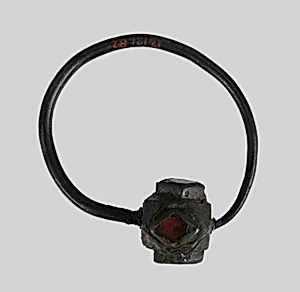
Earring
Unknown Artist
6th–7th centuries
Medium
Silver, garnet or glass paste
Dimensions
Overall: 1 1/2 x 1 7/16 x 1/2 in. (3.8 x 3.6 x 1.2 cm) bead: 1/2 x 1/2 in. (1.2 x 1.3 cm)
Classification
Metalwork-Silver
Culture
Frankish
Department
Medieval Art
Museum
Metropolitan Museum of Art, New York, NY
Credit
Gift of J. Pierpont Morgan, 1917
Accession Number
17.191.82a, b
Rights
Public Domain
Art Historical Context
This delicate Frankish earring, in the 6th–7th, exemplifies the refined metalworking skills of early medieval Europe. Made of silver and adorned with a small bead of garnet or glass paste—measuring just 1/2 x 1/2 inches—the piece is remarkably petite at 1 1/2 x 1 7/16 x 1/2 inches overall. Housed in the Metropolitan Museum of Art's Art department, it entered the collection as a gift from J. Pierpont Morgan in 1917, its enduring allure. Originating from Frankish culture, which dominated much of what is now France and Germany during the Merovingian period, this earring reflects a time of cultural fusion between Germanic traditions and Roman influences. Silver was a practical yet elegant medium for personal adornments like jewelry, while garnets—prized for their deep red hue—symbolized wealth and vitality; glass paste served as an accessible imitation, broadening access to such luxury. Artistically, the earring showcases precise craftsmanship in its construction, likely involving soldering and inlay techniques typical of Frankish metalwork. As a classification of silver metalwork, it offers a glimpse into daily life and status display among the Franks, possibly worn or buried as grave goods, preserving a tangible link to a transformative era in European history.