
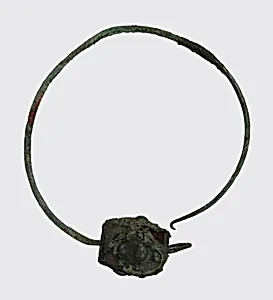
Earring
Unknown Artist
6th–7th century
Medium
Copper alloy, glass paste, garnet (?)
Dimensions
Overall: 3 x 2 5/8 x 3/4 in. (7.6 x 6.6 x 1.9 cm) bead: 13/16 x 3/4 in. (2 x 1.9 cm)
Classification
Metalwork-Copper alloy
Culture
Frankish
Department
Medieval Art
Museum
Metropolitan Museum of Art, New York, NY
Credit
Gift of J. Pierpont Morgan, 1917
Accession Number
17.192.112
Rights
Public Domain
Art Historical Context
This delicate Frankish earring from the 6th–7th exemplifies the exquisite metalwork of the Merovingian period, the Franks dominated much of early medieval Europe, from modern-day France to Germany. Craft from copper alloy and adorned with glass paste and garnet inlays, it measures just 3 x 2⅝ x ¾ inches overall, including a small bead component. Such jewelry was likely worn by women as earrings or pendants, reflecting personal style and social status in a warrior society transitioning from late antiquity to the Middle Ages. The use of affordable copper alloy alongside colorful glass paste—mimicking pricier gems like garnet—highlights innovative techniques in granulation, filigree, or inlay work common among Frankish artisans. These methods allowed for vibrant, lightweight pieces that combined durability with visual appeal, often drawing from Roman and Germanic traditions. Garnet's tentative identification evokes the era's trade networks, sourcing luxury materials from as far as India. A gift to the Metropolitan Museum of Art from J. Pierpont Morgan in 1917, this earring offers a tangible glimpse into everyday elegance amid the Frankish kingdom's rise, reminding us how adornments bridged utility and artistry in turbulent times.