
Earring
Unknown Artist
6th–7th century
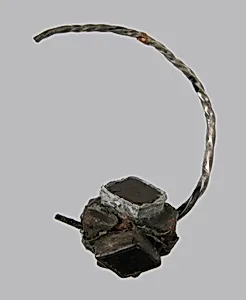
Medium
Silver, traces of gilding, glass paste or garnet (?)
Dimensions
Overall: 1 5/8 x 1 3/16 x 5/8 in. (4.2 x 3 x 1.6 cm) bead: 9/16 x 5/8 in. (1.4 x 1.6 cm)
Classification
Metalwork-Silver
Culture
Frankish
Department
Medieval Art
Museum
Metropolitan Museum of Art, New York, NY
Credit
Gift of J. Pierpont Morgan, 1917
Accession Number
17.192.115
Rights
Public Domain
Art Historical Context
This delicate Frankish earring, crafted in the 6th–7th century during the Merovingian period, exemplifies the exquisite metalwork of early medieval Europe. Made of silver with traces of gilding and inlaid with glass paste or possibly garnet, it measures just 1 5/8 x 1 3/16 x 5/8 inches overall, including a small bead (9/16 x 5/8 inches). Donated to the Metropolitan Museum of Art in 1917 by J. Pierpont Morgan, it now resides in the Medieval Art department, highlighting the artistry of an unknown craftsman from the Frankish culture that dominated what is now France and Germany. Frankish jewelry like this earring was more than mere adornment; it signified social status and wealth amid the turbulent post-Roman world. The Franks, under kings like Clovis and his successors, blended Germanic traditions with Roman influences, producing finely wrought pieces for elite burials and daily wear. Earrings were particularly prized by women, often worn in pairs to frame the face and catch the light. The technique of gilding—applying a thin gold layer to silver—added luxurious shimmer, while the uncertain inlay of glass paste or garnet evoked the colorful cloisonné styles popular in Migration Period artifacts. Though small, this earring reveals the sophisticated craftsmanship of Frankish silversmiths, bridging late antiquity and the Middle Ages with enduring elegance.