
Earring
Unknown Artist
7th century
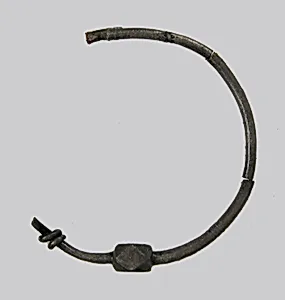
Medium
Silver
Dimensions
Overall: 1 5/16 x 1 1/16 x 3/16 in. (3.4 x 2.7 x 0.4 cm) bead: 3/16 x 3/16 in. (0.5 x 0.4 cm)
Classification
Metalwork-Silver
Culture
Frankish
Department
Medieval Art
Museum
Metropolitan Museum of Art, New York, NY
Credit
Gift of J. Pierpont Morgan, 1917
Accession Number
17.193.43
Rights
Public Domain
Art Historical Context
This exquisite silver earring, crafted by an unknown Frankish artisan in the 7th, exemplifies the delicate metalwork of early medieval Europe. Measuring just 1 5/ x 1 1/16 x 3/16 inches overall, with a tiny bead of 3/16 x 3/16 inches, it was likely worn as a single pendant-style ornament, hooked through the ear. Its petite scale highlights the precision of Frankish silversmiths, who shaped the metal through hammering, soldering, and possibly granulation to create intricate, lightweight jewelry. Originating from the Frankish culture—associated with the Merovingian dynasty that ruled much of Gaul (modern France and Germany)—this piece reflects a transitional era between late antiquity and the Middle Ages. Earrings like this were status symbols for women, blending Germanic traditions with emerging Christian influences, and often buried with their owners as grave goods. Silver, prized for its luster and relative abundance, was a favored medium for personal adornments that signified wealth and identity. Now housed in the Metropolitan Museum of Art's Medieval Art department, this earring was generously gifted by J. Pierpont Morgan in 1917. It offers visitors a tangible glimpse into daily life among the Franks, reminding us how even tiny objects carried profound cultural weight in a world of kings, warriors, and craftsmanship.