
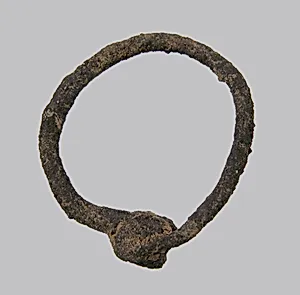
Earring
Unknown Artist
7th century
Medium
Silver(?)
Dimensions
Overall: 11/16 x 5/8 x 3/16 in. (1.7 x 1.6 x 0.4 cm) bead: 3/16 x 3/16 in. (0.4 x 0.4 cm)
Classification
Metalwork-Silver
Culture
Frankish
Department
Medieval Art
Museum
Metropolitan Museum of Art, New York, NY
Credit
Gift of J. Pierpont Morgan, 1917
Accession Number
17.193.82
Rights
Public Domain
Art Historical Context
This delicate silver earring, crafted by an unknown Frankish artisan in the 7th century, a glimpse into the everyday elegance of early medieval Europe. Measuring just 11/16 x 5/8 x 3/16 inches overall—with a tiny 3/16-inch bead exemplifies the fine metalworking skills of the Merovingian Franks, who ruled much of modern-day France and Germany during this era. As Roman influence waned and Christianity spread, such personal adornments became symbols of status and cultural identity, often worn by women to accentuate hairstyles or veils. The earring's classification as metalwork-silver highlights the Franks' mastery of precious metals, likely employing techniques like hammering, soldering, and beading to create lightweight yet intricate jewelry. Its small scale speaks to portability and intimacy, reflecting a society where even modest pieces carried social weight amid trade routes linking the Byzantine East and barbarian West. Donated to the Metropolitan Museum of Art in 1917 by financier J. Pierpont Morgan, this artifact now resides in the Medieval Art department, inviting us to ponder the lives of those who once wore it.