
Earring, One of a Pair
Unknown Artist
12th–13th century
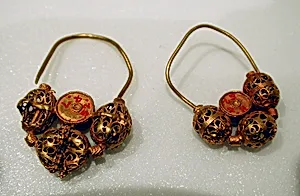
Medium
Gold wire with filigree
Dimensions
H. 1 3/16 in. (3 cm) W. 3/4 in. (1.9 cm) D. 2 3/4 in. (7 cm)
Classification
Jewelry
Department
Islamic Art
Museum
Metropolitan Museum of Art, New York, NY
Credit
Rogers Fund, 1952
Accession Number
52.4.7
Rights
Public Domain
Tags
Art Historical Context
This exquisite gold earring, one of a pair from the 12th–13th, exemplifies the refined artistry of Islamic jewelry during the medieval Islamic world. Crafted from delicate gold wire using the intricate filigree technique—where fine wires are twisted, looped, and soldered into ornate patterns—it measures just 1 3/16 inches high and 3/4 inch wide, yet its depth of 2 3/4 inches suggests a dangling design meant to sway gracefully with movement. Such earrings were likely worn by women of status, adorning earlobes as symbols of wealth and elegance. Filigree, a hallmark of Islamic metalwork from regions like the Middle East and North Africa under Seljuk or Ayyubid influence, showcases the period's mastery of goldsmithing. Artisans heated and hammered gold into thread-like wires, creating lightweight, openwork motifs that allowed light to play through the designs, enhancing their luminous beauty. This technique not only demonstrated technical virtuosity but also reflected Islamic aesthetics favoring geometric complexity and subtle splendor over figurative excess. Housed in the Metropolitan Museum of Art's Islamic Art Department (acquired via the Rogers Fund in 1952), this piece invites visitors to appreciate how everyday adornments carried profound cultural weight—bridging personal style with the era's thriving trade in precious metals and innovative craftsmanship. Imagine the soft chime of these earrings at a bustling medieval bazaar!