
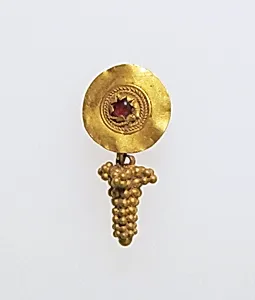
Earring with disc, suspended grapes
Unknown Artist
Medium
Gold, garnet
Dimensions
Other: 1/4 × 1 1/8 × 9/16 in. (0.7 × 2.9 × 1.4 cm)
Classification
Gold and Silver
Department
Greek and Roman Art
Museum
Metropolitan Museum of Art, New York, NY
Credit
Purchase by subscription, 1895
Accession Number
95.15.197
Rights
Public Domain
Tags
About this artwork
This gold and silver titled "Earring with disc, suspended grapes" dates to -7000–330. Executed in gold, garnet, this work exemplifies the craftsmanship associated with Greek and Roman Art. The piece demonstrates the technical skill and artistic vision characteristic of its period. The work's presence in a major museum collection attests to its significance in the broader narrative of art history. As part of institutional holdings, it serves both scholarly research and public education, offering ...
Art Historical Context
This delicate gold earring, titled *Earring with Disc,pended Grapes*, showcases the exquisite jewelry craftsmanship of the ancient Greek and Roman world. Fashioned from gold and inlaid with garnet, it measures just a quarter-inch high and slightly over an inch wide, highlighting the miniaturist's skill in creating wearable luxury for elite wearers. Acquired by the Metropolitan Museum of Art in1895 through public subscription, it now resides in the Greek and Roman Art department, testament to its enduring appeal. The design features a central disc adorned with suspended grape motifs, evoking abundance and perhaps the Dionysian revelry central to ancient Mediterranean culture—grapes symbolizing wine, fertility, and festivity. Though the exact date remains uncertain (spanning broadly from early antiquity to around 330 BCE), the piece exemplifies the technical prowess of goldsmiths in this era, who hammered, granulate, and filigree precious metals into intricate forms. Garnet additions provided vibrant color, enhancing its status as both adornment and status symbol. As a classified gold and silver work, it offers visitors a window into the social values of its time: beauty, opulence, and ritual. Examining it reveals how ancient artisans transformed everyday symbols into timeless art, bridging personal ornament and cultural narrative.