
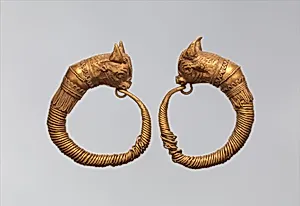
Earring with head of a bull
Unknown Artist
2nd–1st century B.C.
Medium
gold
Dimensions
As Worn: H. 3.2 × W. 3.4 cm (1 1/4 × 1 5/16 in.)
Classification
Earring, bull head
Period
Ptolemaic Period
Department
Egyptian Art
Museum
Metropolitan Museum of Art, New York, NY
Credit
Theodore M. Davis Collection, Bequest of Theodore M. Davis, 1915
Accession Number
30.8.398
Rights
Public Domain
Tags
Art Historical Context
This exquisite gold earring, featuring the finely crafted head of a bull,ails from Egypt's Ptolemaic Period2nd–1st B.C.), a dynamic era when Greek rulers blended Hellenistic influences with deep-rooted Egyptian traditions. Measuring just 3.2 cm high and 3.4 cm wide when worn, its petite scale belies its grandeur, designed as personal adornment for elite wearers. Crafted from pure gold—a metal revered in ancient Egypt for its eternal shine and divine associations—this piece exemplifies the period's masterful jewelry techniques, likely involving repoussé or granulation to achieve intricate details on the bull's horns, ears, and expressive face. The bull motif carries profound cultural weight, symbolizing strength, fertility, and sacred power in Egyptian lore. Bulls were linked to deities like Apis, the living incarnation of the god Ptah, or Hathor, embodying vitality and protection. In Ptolemaic society, such earrings would have served not only as fashionable status symbols but also as talismans, bridging everyday life with the divine. Part of the Theodore M. Davis Collection at The Metropolitan Museum of Art, this artifact offers a glimpse into the opulent world of Ptolemaic elites, where Greco-Egyptian artistry flourished. Imagine dangling from an ear, catching the Nile's sunlight—a tiny testament to ancient reverence for the bull's mighty spirit.