
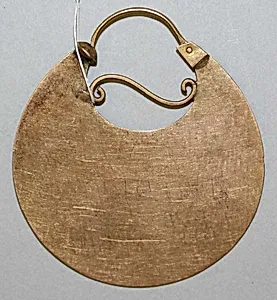
Earrings
Unknown Artist
16th century–19th century
Medium
gold
Classification
Earrings
Culture
probably Spanish
Department
Costume Institute
Museum
Metropolitan Museum of Art, New York, NY
Credit
Museum Accession
Accession Number
X.104.1
Rights
Public Domain
Art Historical Context
These exquisite gold earrings, dating from the 16th to 19th centuries, offer a glimpse into the elegant world of Spanish adornment. Crafted by an unknown artist, they hail from a culture renowned for its opulent jewelry traditions, likely reflecting the influence of Spain's Golden Age through its colonial wealth and Renaissance artistry. Displayed in the Metropolitan Museum Art's Costume Institute, pieces highlight how personal ornaments served as symbols of status, faith, and fashion across centuries of political and artistic upheaval. Gold, the earrings' sole medium, was prized for its malleability and luster, allowing Spanish goldsmiths to create intricate filigree, granulation, or repoussé techniques—methods that emphasized delicacy and shine. Spanning four centuries, they capture evolving tastes: from the ornate Baroque flourishes of the 17th century to the refined neoclassicism of the 19th. As museum accessions, they preserve the tactile beauty of wearable art, inviting visitors to imagine them swaying at courtly dances or religious festivals. Though details on their exact form remain elusive, these earrings embody the enduring allure of Spanish craftsmanship, bridging history and personal expression in the Costume Institute's treasure trove.