
Earspoon
Unknown Artist
ca. 3rd–7th century CE
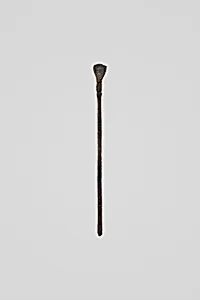
Medium
Bronze
Dimensions
0.5 x 4.5 in. (1.27 x 11.43 cm)
Classification
Metalwork-Implements
Culture & Period
Sasanian · Sasanian
Department
Ancient Near Eastern Art
Museum
Metropolitan Museum of Art, New York, NY
Credit
Rogers Fund, 1932
Accession Number
32.150.197
Rights
Public Domain
Art Historical Context
This delicate bronze earspoon, by an unknown Sasanian artisan around the 3rd to 7th century CE, offers a glimpse into the everyday practices of ancient Persia. Measuring just 0.5 x 4.5 inches, its slender form—likely featuring a looped handle and a small scoop—made it a portable personal tool for removing earwax, reflecting the practical ingenuity of Sasanian daily life. The Sasanian Empire (–651 CE), which spanned modern-day Iran and beyond, was renowned for its masterful metalworking traditions, blending influences from Parthian, Roman, and Central Asian cultures. Bronze, a durable and affordable alloy of copper and tin, was ideal for such utilitarian implements, showcasing advanced casting and finishing techniques that produced smooth, functional surfaces. These objects highlight the empire's sophisticated craftsmanship, often reserved for elite households despite their mundane purpose. Acquired through the Rogers Fund in 1932 and now housed in the Metropolitan Museum of Art's Department of Ancient Near Eastern Art, this earspoon bridges the gap between luxury arts and ordinary routines, reminding us how small artifacts illuminate the rhythms of ancient societies.